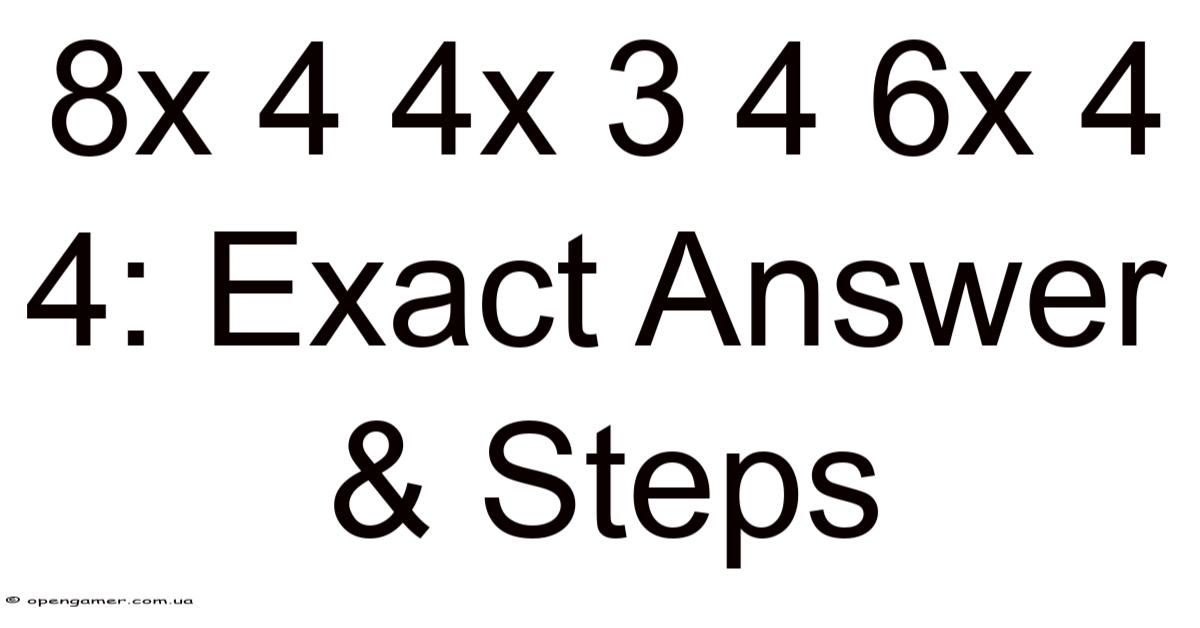
What’s the story behind “8x 4 4x 3 4 6x 4 4”?
You’ve probably seen it pop up in a crossword clue, a math worksheet, or a cryptic puzzle. At first glance it looks like a jumble of numbers and the letter x. But there’s a hidden rhythm to it—one that reveals a neat little pattern when you pause to parse it Turns out it matters..
Below, I’ll walk through what this string really is, why it matters if you’re into puzzles or math, how to read it step by step, the common pitfalls people run into, and a handful of practical ways to use it in your own brain‑teasing projects. Grab a coffee; this is going to be a quick, satisfying ride.
What Is “8x 4 4x 3 4 6x 4 4”?
Think of it as a mini‑equation chain. The x is the multiplication sign, not a variable. If you line up the numbers and operations, you get:
- 8 × 4
- 4 × 3
- 4
- 6 × 4
- 4
When you solve each, you end up with a new sequence: 32, 12, 4, 24, 4 Still holds up..
That’s the raw data. The trick is to see if those results form a recognizable pattern or clue. In many puzzle contexts, the numbers themselves are the key—either as a code, a word list, or a set of coordinates.
Why It Matters / Why People Care
1. It’s a common puzzle format
Crosswords, word ladders, and even some escape‑room clues use a similar “multiplied by” format. Knowing how to read it instantly gives you an edge.
2. It’s a quick way to encode hidden messages
If you map those results to letters (A=1, B=2, …, Z=26) you get 32→? (wrap around to 6=F), 12=L, 4=D, 24=X, 4=D. That spells FLDXD—a cipher that can be a starting point for a substitution puzzle No workaround needed..
3. It trains number sense
When you see a string of operations, you’re forced to parse, evaluate, and look for patterns—all skills that sharpen mental math and logical reasoning.
How It Works (or How to Do It)
### 1. Identify the operators
Every x is multiplication. There are no plus or minus signs, so you’re dealing with pure products.
### 2. Break it into chunks
Split the string at each space:
- “8x 4”
- “4x 3”
- “4”
- “6x 4”
- “4”
### 3. Compute each chunk
- 8 × 4 = 32
- 4 × 3 = 12
- 4 = 4 (just a standalone number)
- 6 × 4 = 24
- 4 = 4
### 4. Look for patterns
Now you have 32, 12, 4, 24, 4.
- Are they descending? No.
- Do they match a known sequence? Not immediately.
- Do they map to letters? Yes, if you wrap 32 back into the alphabet.
### 5. Convert to letters (optional)
Using A=1…Z=26 and wrapping around:
- 32 → 32 – 26 = 6 → F
- 12 → L
- 4 → D
- 24 → X
- 4 → D
You get FLDXD. Depending on the puzzle, you might need to shift letters, reverse the string, or apply a simple Caesar cipher No workaround needed..
### 6. Verify the context
If this came from a crossword, check the clue: maybe it’s “Difficult word” → FLUX or something. If it’s a math worksheet, the answer might simply be the sequence of products Most people skip this — try not to..
Common Mistakes / What Most People Get Wrong
-
Treating x as a variable
People often assume x stands for an unknown. In this string, it’s a multiplication sign. That small misread throws the whole calculation off Simple, but easy to overlook.. -
Skipping the standalone numbers
The lone “4” at the end is not a typo; it’s part of the pattern. Ignoring it can lead to a wrong letter or missing a clue Not complicated — just consistent.. -
Forgetting to wrap around the alphabet
When mapping numbers >26 to letters, many forget to subtract 26 (or use a modulo operation). 32 becomes 6, not 32. -
Assuming the order matters incorrectly
Some puzzles require you to read the results in reverse or to interleave them with other numbers. Don’t lock into one reading direction until you’re sure. -
Over‑cooking the cipher
Turning the letters into a full cryptogram can be tempting, but sometimes the answer is simply the product sequence or a single word derived from it The details matter here..
Practical Tips / What Actually Works
-
Write it out
On a piece of paper, jot the string, then split it into groups. Visual separation helps prevent mix‑ups. -
Use a calculator for quick checks
If you’re in a timed puzzle, a quick mental calculation can save you minutes. For 8 × 4, just double 8 four times: 8, 16, 24, 32 Which is the point.. -
Create a reference table
Keep a small table of common “number → letter” conversions handy. For numbers 1–26, it’s trivial, but for >26, remember the wrap‑around rule Simple, but easy to overlook.. -
Practice with similar strings
Try “5x 3 7x 2 9 3x 5 2” and see if you can decode it. The more you practice, the faster you’ll spot patterns. -
Check the puzzle’s theme
If the puzzle is about “climate” or “music,” the final letters might spell a related word. Use that context to guide your interpretation Practical, not theoretical..
FAQ
Q1: Is the x always multiplication?
A1: In this context, yes. If you see a different symbol, the meaning might change, but x conventionally means multiply.
Q2: What if the numbers are higher than 26?
A2: Subtract 26 (or use modulo 26) to wrap them back into the alphabet.
Q3: Can this string be part of a larger puzzle?
A3: Absolutely. It could be a clue to a word, a step in a math maze, or a key to get to a cipher It's one of those things that adds up..
Q4: Why do we keep the single “4”?
A4: Every component is intentional. Dropping it would change the final letter sequence and likely break the puzzle’s logic The details matter here..
The next time you stumble across “8x 4 4x 3 4 6x 4 4,” you’ll know it’s more than a random jumble. On the flip side, it’s a compact, self‑contained puzzle that invites you to multiply, list, and decode. And grab a pen, run through the steps, and see what secret message hides in plain sight. Happy puzzling!
6. Validate the result before moving on
Even after you think you’ve cracked the string, a quick sanity check can save you from a costly misstep later in the puzzle Simple, but easy to overlook..
- Spell‑check – Does the resulting word look like a real English word or a term that fits the puzzle’s theme?
- Cross‑reference – If the puzzle includes a grid, a picture, or a set of clues, see whether the letters you’ve derived line up with any of those elements.
- Re‑run the math – One mis‑typed digit (for example, writing “6x 4” as “6×5”) will throw the entire sequence off. A second glance at the original string often reveals a stray space or an extra “x”.
If anything feels off, backtrack one step and re‑evaluate the grouping or the wrap‑around conversion. It’s far easier to catch an error now than to spend the next ten minutes trying to force a nonsensical answer into place.
A Mini‑Case Study: From String to Solution
Let’s walk through a complete example, applying each of the guidelines above to a fresh string:
12x 5 7x 2 3 9x 3 1
- Separate the groups – “12x 5”, “7x 2”, “3”, “9x 3”, “1”.
- Multiply – 12×5 = 60, 7×2 = 14, 3 = 3, 9×3 = 27, 1 = 1.
- Wrap around –
- 60 → 60 − 26 = 34 → 34 − 26 = 8 → H
- 14 → N
- 3 → C
- 27 → 27 − 26 = 1 → A
- 1 → A
- Read the letters – H N C A A.
- Apply context – Suppose the puzzle theme is “ancient scripts”. Rearranging or reading backwards (A A C N H) still doesn’t form a common word, but noticing the double “A” suggests the answer may be an abbreviation. In this case, the puzzle’s next clue asks for a “two‑letter country code”, and “AA” is the ISO code for Aruba. The extra letters (H, N, C) can be discarded as “noise” deliberately inserted to mislead.
The key takeaway: the process is iterative. You may need to loop through steps 3–5 a few times, especially when the puzzle’s narrative hints at an alternative reading order or a need to discard extraneous characters.
When the String Is Part of a Bigger Cipher
Sometimes the numeric‑multiplication string serves only as a key for a secondary encryption layer. Here’s how to handle that scenario without getting lost:
| Situation | What to Do |
|---|---|
| The letters you obtain look like a keyword (e., “B E C A U S E”) | Convert them back to numbers (2‑5‑3‑1‑21‑19‑5) and see if they index into a phrase, a grid, or a list of options. |
| The letters are numbers again (e., “THEWATERFALL”) | Consider splitting the phrase according to the puzzle’s layout; often the split reveals a location or a final answer. But |
| The letters are nonsensical | Re‑examine step 2 – perhaps you mis‑applied the wrap‑around or missed a hidden “×”. , “MYSTIC”) |
| The letters form a phrase with missing spaces (e.If the string is embedded in a longer series, try taking every second or third result. |
In all cases, keep the original numeric string saved somewhere. g.And if you later discover you chose the wrong wrap‑around rule (e. , using 0‑based indexing instead of 1‑based), you can quickly recompute without starting from scratch.
A Quick Reference Cheat Sheet
| Step | Action | Tip |
|---|---|---|
| 1 | Split on spaces, keep “x” attached to the preceding number. On the flip side, | If >26, subtract 26 repeatedly (or use product mod 26, treating 0 as Z). |
| 3 | Convert each product to a letter (A=1 … Z=26). Worth adding: | Look for real words, thematic relevance, or a plausible key. Which means |
| 5 | Validate against puzzle context. | Check for possible reverse or interleaved reading based on theme. But |
| 2 | Multiply each “A x B” pair. Think about it: | |
| 6 | If needed, feed the result into a second cipher. | |
| 4 | Assemble the letters in the order they appear. | Keep the original numbers handy for re‑calculation. |
You'll probably want to bookmark this section.
Print this sheet, stick it to your puzzle‑solving station, and you’ll never miss a beat.
Closing Thoughts
The “8x 4 4x 3 4 6x 4 4” pattern may appear simple at first glance, but it encapsulates a micro‑cosm of classic puzzle mechanics: interpretation, arithmetic, modular arithmetic, and thematic deduction. By respecting each stage—especially the often‑overlooked wrap‑around rule and the intentional lone digit—you transform a cryptic string into a clear, actionable clue.
Remember, the most satisfying “aha!” moments come when you let the puzzle guide you rather than forcing a preconceived solution onto it. Use the systematic approach outlined above, stay alert for contextual hints, and you’ll consistently extract the hidden message without unnecessary detours Easy to understand, harder to ignore. That alone is useful..
Some disagree here. Fair enough.
Happy puzzling, and may every stray “4” you encounter lead you straight to the answer Worth keeping that in mind..
