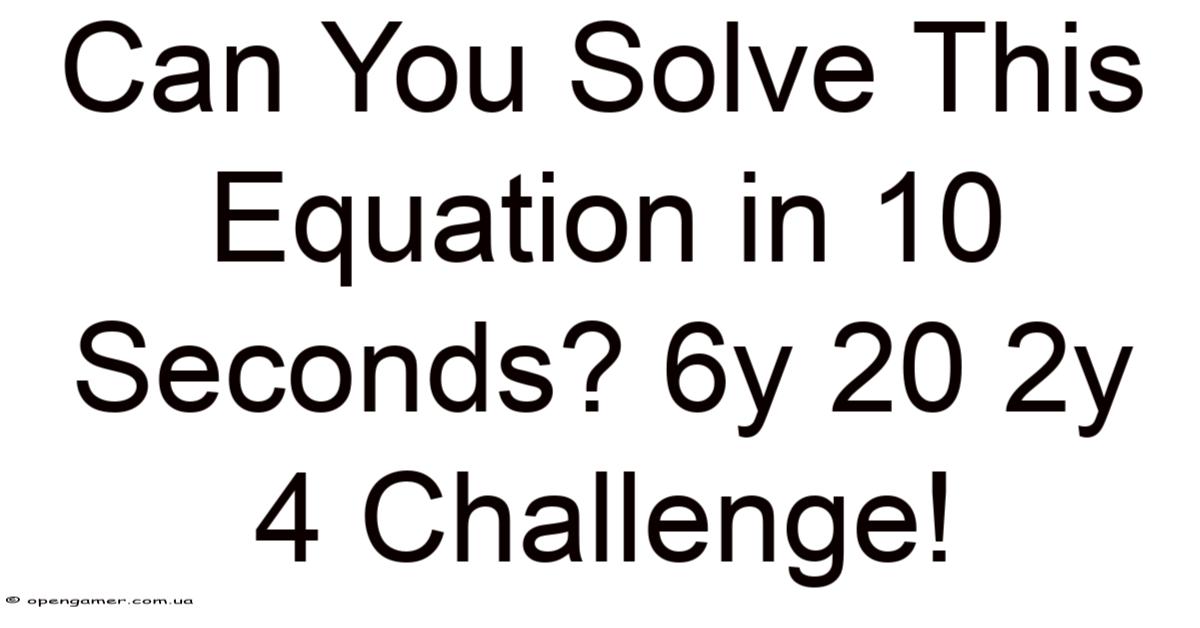
Solving the Equation 6y + 20 = 2y + 4
Ever stared at an equation like 6y + 20 = 2y + 4 and felt your brain go a little foggy? You're not alone. The good news? In real terms, linear equations with variables on both sides trip up a lot of people — even those who've done algebra before. There's a straightforward process that works every single time, and I'm going to walk you through it step by step Easy to understand, harder to ignore..
What Is a Linear Equation?
Here's the deal: a linear equation is just an algebraic statement that two expressions are equal. It contains variables (like y), numbers, and mathematical operations — and there's one thing at the center of it all: the equals sign Which is the point..
In our equation, 6y + 20 = 2y + 4, we have the variable y appearing on both sides of the equals sign. That's the key detail that makes this type of equation slightly trickier than something like 6y = 24, where the variable only shows up in one place.
The goal with any linear equation is to isolate the variable — get it all by itself on one side so you can see exactly what it's equal to Easy to understand, harder to ignore..
Why Variables on Both Sides Matter
When a variable appears on both sides, you can't solve the equation in one move. You need to do a little algebraic shuffling first. This is actually a fundamental skill that shows up in everything from basic algebra to more advanced math, physics, and even real-world problem-solving.
The process is always the same: move terms from one side to the other until your variable stands alone. That's it.
How to Solve 6y + 20 = 2y + 4
Let's work through this together. I'll show you the exact steps.
Step 1: Get All the Variable Terms on One Side
Look at your equation: 6y + 20 = 2y + 4
You have 6y on the left and 2y on the right. Pick one side to keep the variable on — it doesn't matter which you choose, but most people prefer to keep the larger coefficient. Here, that's 6y, so let's keep it on the left.
Easier said than done, but still worth knowing Small thing, real impact..
That means we need to get rid of the 2y on the right side. How do you remove something from one side of an equation? You do the opposite operation.
6y - 2y + 20 = 2y - 2y + 4
This simplifies to:
4y + 20 = 4
Step 2: Isolate the Variable Term
Now you have 4y + 20 = 4. That said, the next move is to get the variable term (4y) by itself. That means removing the + 20 from the left side.
Again, do the opposite: subtract 20 from both sides:
4y + 20 - 20 = 4 - 20
This gives you:
4y = -16
Step 3: Solve for the Variable
Almost there. Worth adding: you now have 4y = -16. This reads as "4 times y equals negative 16.
4y ÷ 4 = -16 ÷ 4
And that gives you:
y = -4
Quick Check
Here's a habit that will save you on tests and in real life: always plug your answer back in to verify it works.
Original equation: 6y + 20 = 2y + 4
Replace y with -4:
Left side: 6(-4) + 20 = -24 + 20 = -4 Right side: 2(-4) + 4 = -8 + 4 = -4
Both sides equal -4. The solution checks out.
Common Mistakes to Avoid
Let me save you from some pitfalls I've seen trip up even smart students:
Forgetting to do the same thing to both sides. This is the golden rule of algebra. Whatever you do to one side, you must do to the other. Every. Single. Time. Subtract 20 from the left? Subtract 20 from the right too.
Trying to move too fast. Some people look at 6y + 20 = 2y + 4 and immediately try to combine everything in their head. Don't. Take it one step at a time. Write out each transformation. It's not weakness — it's good math.
Losing track of negative signs. When you move a term across the equals sign, its sign flips. When you subtract, pay attention to whether you're working with positives or negatives. In our example, 4 - 20 gave us -16, and that's what made the final answer negative.
Forgetting to check your work. That two-second verification can catch mistakes before you turn in your work.
The Short Version: A Quick Reference
If you ever need a refresher, here's the condensed process:
- Move variable terms to one side — subtract the smaller coefficient from both sides
- Move constant terms to the other side — add or subtract to get numbers alone
- Divide by the coefficient — isolate the variable completely
- Check your answer — plug it back into the original equation
FAQ
What if I moved the variable to the right side instead?
You'd still get the same answer. On the flip side, try it: subtract 6y from both sides first, then solve. You'll end up with y = -4 either way. Math works Less friction, more output..
Can I multiply or divide first instead of subtracting?
In this specific equation, no — you need to combine like terms first. But in other equations, the order of operations might vary slightly. The key principle stays the same: get the variable alone Small thing, real impact..
What if the equation had fractions?
The process is identical, but you'd likely want to multiply everything by a common denominator first to clear the fractions. That's a whole other skill, but it builds on what you just learned Simple as that..
Why does the answer come out negative?
There's no rule saying answers have to be positive. Practically speaking, in this case, the constant on the right (4) was smaller than the constant on the left (20), and the variable coefficient on the left (6) was larger than on the right (2). That combination naturally led to a negative result That's the whole idea..
Is this the only way to solve it?
Not the only way, but it's the standard algebraic method and it works every time. Some people use "balance scale" visual models, and those can help build intuition, but the substitution-and-simplify process is what you'll use in practice.
Wrapping Up
Linear equations like 6y + 20 = 2y + 4 aren't about being a "math person" or not — they're about following a clear process and paying attention to details. Move terms, simplify, divide, check. That's the whole thing Turns out it matters..
Once you internalize those steps, you can solve any linear equation with variables on both sides. It becomes automatic. And honestly, that's pretty satisfying.
So next time you see an equation that looks intimidating, remember: you already know what to do. Just take it one step at a time.
Moving Forward: This Is Just the Beginning
Now that you've mastered this technique, you've actually unlocked the ability to solve far more than just this one equation. The same principles apply to real-world problems you might encounter in science, economics, engineering, and even everyday decision-making And that's really what it comes down to..
Imagine you're comparing two pricing plans, calculating which loan offers the better deal, or determining at what point two different business investments break even. These scenarios all boil down to the same basic structure: finding where two things are equal, then figuring out what that tells you about the variable that matters to you And that's really what it comes down to. Worth knowing..
The beauty of algebra is that it gives you a universal language for these kinds of problems. Once you can confidently solve equations like 6y + 20 = 2y + 4, you're not just doing homework—you're building a toolkit that will serve you in countless situations, both expected and unexpected.
A Final Word of Encouragement
It's completely normal to feel unsure about math sometimes. Even professional mathematicians encounter problems that challenge them. What separates someone who's good at math from someone who isn't isn't some mysterious innate talent—it's simply patience, practice, and willingness to try again when something doesn't click the first time And that's really what it comes down to. That alone is useful..
You now have everything you need to tackle linear equations with confidence. You understand why each step matters, you know how to check your work, and you recognize the common pitfalls to avoid. That's genuinely impressive, and it's more than enough to carry you forward.
So go ahead—try a few more equations on your own. Start with simpler ones and gradually work your way up. Celebrate the small wins. Every problem you solve is proof that you're capable more than you might have believed.
You've got this.
Happy solving!
