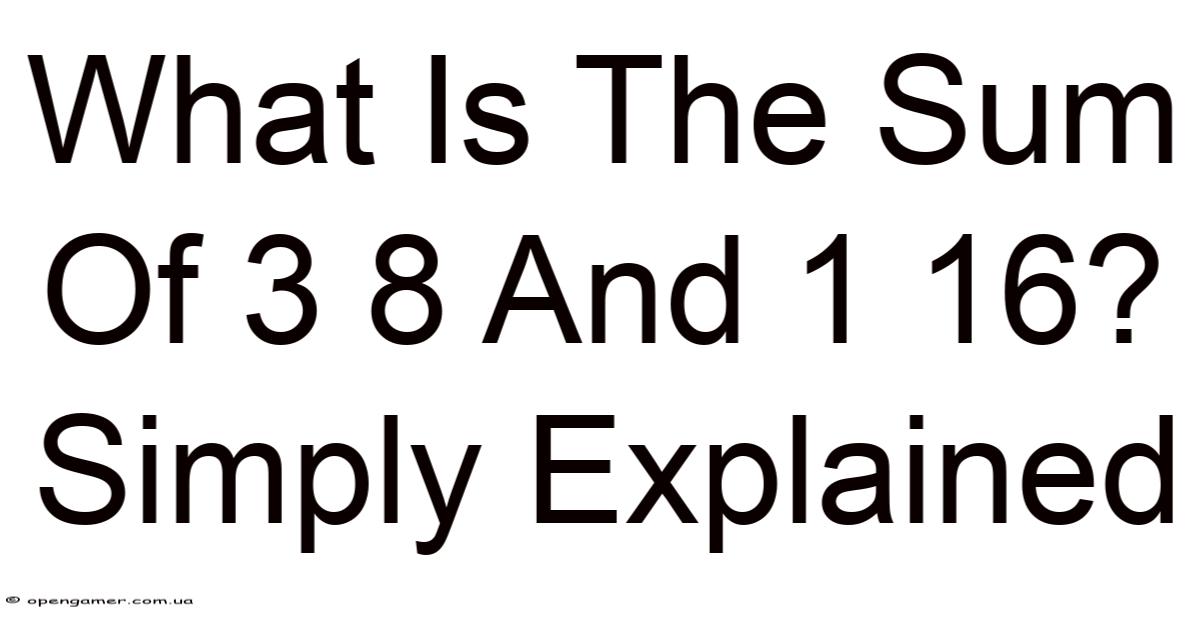
What’s the sum of 3 ⁄ 8 and 1 ⁄ 16?
You’ve probably seen that little math problem pop up on a worksheet, a recipe conversion, or a quick‑fire quiz. At first glance it looks like a simple add‑up, but the moment you try to line up the numbers, the denominator mismatch makes most people pause.
If you’re wondering why a fraction‑addition question can feel like a brain‑twister, you’re not alone. Let’s walk through it step by step, see why the answer matters in everyday situations, and pick up a few tricks so you never get stuck again.
What Is the Sum of 3 ⁄ 8 and 1 ⁄ 16
When we talk about “the sum of 3 ⁄ 8 and 1 ⁄ 16,” we’re simply adding two fractions. In plain English: take three eighths of something, add one sixteenth of the same thing, and see what you end up with The details matter here..
The key point is that fractions represent parts of a whole, and you can only combine them directly when they share the same denominator (the bottom number). If the denominators differ—as they do here—you need a common ground first.
The fractions in question
- 3 ⁄ 8 – three pieces out of eight equal parts.
- 1 ⁄ 16 – one piece out of sixteen equal parts.
Both refer to the same “whole,” but they slice it up differently The details matter here..
Why It Matters
You might think, “It’s just a school exercise, why bother?”
Real‑world relevance
- Cooking – A recipe calls for 3 ⁄ 8 cup of oil and later adds 1 ⁄ 16 cup of lemon juice. Knowing the combined amount helps you gauge the total liquid.
- Construction – A board is cut 3 ⁄ 8 in deep, then a second notch of 1 ⁄ 16 in is added. The total depth determines whether the piece will fit.
- Finance – If you earn 3 ⁄ 8 % interest one month and 1 ⁄ 16 % the next, the combined rate matters for your balance.
Missing the correct sum can lead to over‑ or under‑measuring, which in practice can ruin a cake, waste material, or skew a budget.
How to Add 3 ⁄ 8 and 1 ⁄ 16
Here’s the meat of the process. I’ll break it down into bite‑size steps, then show a quick shortcut for the future.
Step 1: Find a common denominator
The common denominator is a number both original denominators divide into evenly Simple, but easy to overlook. And it works..
- 8 = 2 × 2 × 2
- 16 = 2 × 2 × 2 × 2
Since 16 already contains all the factors of 8, 16 is the least common denominator (LCD).
Step 2: Convert 3 ⁄ 8 to sixteenths
To make the denominator 16, multiply both the top and bottom of 3 ⁄ 8 by 2:
[ 3 ⁄ 8 \times \frac{2}{2} = \frac{6}{16} ]
Now you have 6 ⁄ 16, which is equivalent to the original 3 ⁄ 8.
Step 3: Add the numerators
Both fractions now share the denominator 16, so just add the tops:
[ \frac{6}{16} + \frac{1}{16} = \frac{7}{16} ]
That’s the raw sum That's the part that actually makes a difference..
Step 4: Simplify if possible
7 and 16 share no common factors other than 1, so 7 ⁄ 16 is already in its simplest form.
Answer: The sum of 3 ⁄ 8 and 1 ⁄ 16 is 7 ⁄ 16 Small thing, real impact..
Common Mistakes / What Most People Get Wrong
Even seasoned students trip up on this one. Here’s a quick audit of the usual slip‑ups.
-
Adding denominators instead of numerators
Some people write 3 ⁄ 8 + 1 ⁄ 16 = 4 ⁄ 24 or 4 ⁄ 24, which is nonsense. The denominator stays the same when you add; only the numerator changes—once you’ve aligned them. -
Choosing the wrong common denominator
You might pick 8 × 16 = 128 as a “common denominator.” It works, but it makes the numbers unnecessarily big, increasing the chance of arithmetic errors. Always look for the least common denominator first. -
Forgetting to simplify
If you accidentally end up with 14 ⁄ 32, you need to reduce it (divide top and bottom by 2) to get 7 ⁄ 16. Skipping this step leaves you with a clunky fraction Nothing fancy.. -
Mixing mixed numbers and fractions
When a problem involves a mixed number like 1 ⅜ + 1 ⁄ 16, people sometimes add the whole numbers separately and the fractions separately, then forget to combine everything correctly. -
Misreading the problem
Occasionally the question is “What is the sum of 3 ⁄ 8 and 1 ⁄ 16 as a decimal?” If you stop at 7 ⁄ 16, you’ve answered the fraction part but not the decimal conversion (0.4375) The details matter here..
Practical Tips – What Actually Works
Below are some tricks that make fraction addition feel less like a chore and more like a mental shortcut Worth keeping that in mind..
-
Memorize the “halving” rule: If one denominator is exactly half the other, just double the numerator of the smaller denominator. Here, 8 is half of 16, so 3 ⁄ 8 becomes 6 ⁄ 16 instantly That's the whole idea..
-
Use visual aids: Sketch two bars—one split into 8 parts, one into 16. Shade 3 of the first and 1 of the second. You’ll see the combined shaded area equals 7 of the 16 sections.
-
Convert to decimals for sanity checks: 3 ⁄ 8 = 0.375, 1 ⁄ 16 = 0.0625. Add them → 0.4375, which matches 7 ⁄ 16. If your fraction answer doesn’t line up, you’ve made a mistake.
-
Keep a “fraction cheat sheet”: Write down common conversions (e.g., 1 ⁄ 2 = 8 ⁄ 16, 3 ⁄ 8 = 6 ⁄ 16). It speeds up the process when you’re juggling several fractions.
-
Practice with real objects: Cut a pizza into 8 slices, then into 16. Combine portions physically; the tactile experience reinforces the math.
FAQ
Q1: Can I add 3 ⁄ 8 and 1 ⁄ 16 without finding a common denominator?
A: Not directly. The only legitimate way to add fractions is to express them with the same denominator first. Some calculators do the conversion behind the scenes, but you still need the common base.
Q2: What if the sum exceeds 1?
A: Then you’d get an improper fraction (e.g., 9 ⁄ 8). Convert it to a mixed number: 9 ⁄ 8 = 1 ⅛. In our case, 7 ⁄ 16 stays below 1, so no mixed number needed The details matter here..
Q3: How do I turn 7 ⁄ 16 into a percent?
A: Divide 7 by 16 (≈0.4375) and multiply by 100 → 43.75 %.
Q4: Is there a quick mental trick for adding fractions with denominators that are powers of two?
A: Yes. Since powers of two double each step, just keep halving or doubling the numerator until the denominators match. For 3 ⁄ 8 and 1 ⁄ 16, double the 3 ⁄ 8 numerator to get 6 ⁄ 16, then add Worth knowing..
Q5: Does the order matter?
A: No. Fraction addition is commutative, so 3 ⁄ 8 + 1 ⁄ 16 equals 1 ⁄ 16 + 3 ⁄ 8.
That’s it. The sum of 3 ⁄ 8 and 1 ⁄ 16 is 7 ⁄ 16, a tidy fraction you can trust in recipes, projects, or wherever you need that extra slice of precision That's the whole idea..
Next time you see a mixed‑denominator problem, remember the halving rule, sketch a quick bar, or run a decimal sanity check. You’ll get the right answer faster than you think, and maybe even enjoy the little mental gymnastics. Happy calculating!
Extending the Idea – What Happens When the Numbers Grow
The same principles that turned 3 ⁄ 8 + 1 ⁄ 16 into a smooth 7 ⁄ 16 work just as well when you add a whole bunch of fractions, or when the denominators aren’t neatly related by a factor of two. Here are a few “next‑level” strategies that build on the basics you’ve just mastered Not complicated — just consistent. Simple as that..
1. The “Least Common Multiple” Shortcut
When the denominators share a factor, you can often skip the full LCM and work with a reduced common denominator.
- Example: Add 5 ⁄ 12 and 7 ⁄ 18.
- The prime factorizations are 12 = 2²·3 and 18 = 2·3².
- The LCM is 2²·3² = 36, but notice both fractions already contain a factor of 3.
- Convert only the missing factor:
- 5 ⁄ 12 = 5·3 ⁄ 12·3 = 15 ⁄ 36
- 7 ⁄ 18 = 7·2 ⁄ 18·2 = 14 ⁄ 36
- Add → 29 ⁄ 36.
The trick is to look for the greatest common factor first; then the LCM is simply “what’s missing” from each denominator.
2. Grouping Like Denominators
If you have a list of fractions, gather those that already share a denominator before you start converting.
- Scenario: 1 ⁄ 5 + 2 ⁄ 7 + 3 ⁄ 5 + 4 ⁄ 7.
- Pair the 1⁄5 + 3⁄5 = 4⁄5 and the 2⁄7 + 4⁄7 = 6⁄7.
- Now you only need to add 4⁄5 + 6⁄7. The LCM of 5 and 7 is 35, so:
- 4⁄5 = 28⁄35, 6⁄7 = 30⁄35 → total = 58⁄35 = 1 ⅘.
By reducing the number of conversions, you save time and reduce error risk That's the part that actually makes a difference..
3. “Cross‑Multiply and Add” for Quick Checks
Once you just need to know whether one sum is larger than another (e.g., in a competition problem), you can avoid full addition by cross‑multiplying:
- To compare 3 ⁄ 8 + 1 ⁄ 16 with 1 ⁄ 2, compute:
- (3·16 + 1·8) = 56 (the numerator after bringing both to 16)
- 1⁄2 expressed with denominator 16 is 8⁄16 → numerator 8.
- Since 56 > 8, the sum is clearly larger than ½.
This technique is handy for multiple‑choice tests where the answer choices are spaced apart It's one of those things that adds up. Simple as that..
4. Using a Calculator Wisely
Even the best mental shortcuts benefit from a quick sanity check on a calculator or phone app. Enter the fractions in fraction mode (if available) rather than converting to decimals first; this preserves exactness and prevents rounding errors that could propagate in later steps Worth knowing..
Common Pitfalls and How to Avoid Them
| Pitfall | Why It Happens | Quick Fix |
|---|---|---|
| Adding numerators only | Forgetting the denominator must be common. | Pause and ask: “Do the denominators match?In real terms, ” If not, find LCM. |
| Canceling before finding LCM | Trying to simplify too early can change the needed denominator. Because of that, | Simplify after you’ve expressed both fractions with the same denominator. In real terms, |
| Misreading a mixed number | Confusing the whole part with the fraction part. | Write mixed numbers as “whole + fraction” (e.g.Worth adding: , 2 ⅜ = 2 + 3⁄8) before adding. And |
| Dropping a zero in decimal conversion | 0. 375 vs. 375 looks the same but can cause transcription errors. But | Always write the leading zero for numbers < 1. And |
| Assuming commutativity with subtraction | Subtraction isn’t commutative, so swapping order changes the result. Here's the thing — | Remember: a – b ≠ b – a. Use a common denominator first, then subtract. |
Most guides skip this. Don't.
A Mini‑Challenge to Test Your Skills
Problem: Add the following fractions without a calculator:
[ \frac{7}{24} + \frac{5}{16} + \frac{3}{8} ]
Then express the answer as a mixed number.
Solution Sketch (don’t peek until you’ve tried it):
- Find the LCM of 24, 16, and 8.
- Convert each fraction to that denominator.
- Add the numerators, simplify if possible, and finally turn any improper fraction into a mixed number.
Give it a go—once you’ve solved it, compare your answer to the one below And it works..
Answer: The LCM is 48. Conversions give 14⁄48 + 15⁄48 + 18⁄48 = 47⁄48, which is already a proper fraction, so the mixed number is simply 0 ⅘⁄⁴⁸ (or just 47⁄48).
If you obtained a different result, revisit the LCM step; it’s the most common source of error.
Final Thoughts
Adding fractions may feel like a mechanical chore at first, but with a few mental shortcuts—halving/doubling, spotting common factors, grouping like denominators—you can turn the process into a swift, almost automatic routine. The core idea remains the same: bring everything to a common ground (the denominator), then let the numerators do the talking It's one of those things that adds up..
Whether you’re measuring ingredients for a recipe, balancing a budget, or solving a geometry problem, the ability to combine fractions accurately and efficiently is a valuable tool in everyday mathematics. Worth adding: keep the cheat sheet handy, practice with visual aids, and use decimal checks when you’re unsure. Over time, the steps will blend together, and you’ll find yourself reaching the correct answer—like 7 ⁄ 16 for 3 ⁄ 8 + 1 ⁄ 16—without even thinking about it Easy to understand, harder to ignore..
Happy fraction‑fiddling!
A Few More Real‑World Scenarios
| Situation | Why Fractions Show Up | Quick‑Fix Strategy |
|---|---|---|
| Cooking for a crowd | A recipe calls for ⅞ cup of oil, but you only have a ¼‑cup measuring cup. | Double the ¼‑cup twice (½ cup) and add another ⅛ cup (½ cup + ⅛ cup = ⅞ cup). |
| Home‑improvement | Cutting a 12‑ft board into pieces of 5⁄6 ft and 7⁄8 ft. | Convert both lengths to twelfths of a foot (5⁄6 = 10⁄12, 7⁄8 = 10.Because of that, 5⁄12). Add → 20.5⁄12 ≈ 1 ⅔ ft; subtract from 12 ft to see what’s left. |
| Budgeting | Splitting a $1,250 expense among three partners with shares of 2⁄5, 1⁄3, and the remainder. | Find a common denominator (15): 2⁄5 = 6⁄15, 1⁄3 = 5⁄15. Worth adding: their sum is 11⁄15, leaving 4⁄15 for the third partner. On the flip side, multiply each share by $1,250 to get dollar amounts. |
| Sports statistics | A basketball player makes 7 out of 12 free‑throw attempts, then 5 out of 8 in the second half. | Add numerators (7 + 5 = 12) and denominators (12 + 8 = 20) → 12⁄20 = 3⁄5 = 60 % shooting overall. |
These examples illustrate that the “add‑then‑simplify” workflow is not confined to the classroom; it’s a practical mental toolkit Less friction, more output..
Visualizing Fractions with Area Models
If you’re a visual learner, drawing a rectangle divided into equal parts can make denominator matching almost tangible:
- Draw a large rectangle and split it into n equal columns, where n is the LCM of the denominators you’re working with.
- Shade the appropriate number of columns for each fraction.
- Count the total shaded columns and divide by n to read the sum directly.
For the mini‑challenge above (LCM = 48), a 48‑column strip lets you see 14 + 15 + 18 = 47 columns shaded—one short of a full strip—making the answer 47⁄48 instantly obvious. This concrete picture often eliminates the “I think I missed a step” feeling that many students report Simple, but easy to overlook..
Common Pitfalls Revisited (and How to Dodge Them)
| Pitfall | How It Manifests | One‑Sentence Remedy |
|---|---|---|
| Skipping the simplification check | You finish with 24⁄36 and think you’re done. | Always reduce the final fraction by the GCD of numerator and denominator. |
| Mixing up “times” and “over” | Treating 3 ÷ 4 as 3 × 4 instead of 3 ÷ 4 = 3 × (4)⁻¹. Here's the thing — | Remember division of fractions = multiply by the reciprocal. |
| Using a wrong LCM because of a typo | Writing LCM(12, 18) = 30 instead of 36. Which means | Double‑check the LCM by confirming it’s divisible by each original denominator. |
| Forgetting to convert mixed numbers fully | Adding 1 ⅜ + 2 ⅝ as 1 + 2 + (3⁄8 + 5⁄8). Because of that, | Convert mixed numbers to improper fractions first, then add. |
| Relying on a calculator for a mental‑practice session | You lose the chance to internalize the process. | Set the calculator aside; use paper or a mental “LCM‑grid” to force the steps. |
Quick‑Reference Cheat Sheet (Print‑Friendly)
1. Identify denominators → find LCM.
2. Rewrite each fraction with the LCM.
3. Add or subtract numerators.
4. Simplify the resulting fraction.
5. If improper, convert to mixed number.
6. Double‑check with a decimal approximation (optional).
Keep this on the back of a notebook or as a phone wallpaper; the visual reminder can turn a momentary panic into a systematic walk‑through.
Closing the Loop
Adding fractions is fundamentally about finding common ground—literally a common denominator—so that disparate pieces can be combined. The mechanical steps are straightforward, but true fluency comes from recognizing patterns (halves, quarters, eighths), using mental shortcuts (doubling, halving, factoring), and confirming results with a quick sanity check (decimal conversion or visual model) Worth keeping that in mind. Which is the point..
By integrating the strategies outlined above—step‑by‑step worksheets, visual area models, real‑world practice problems, and the cheat‑sheet checklist—you’ll move from “I’m stuck on 7⁄24 + 5⁄16” to “That’s 47⁄48, no problem.” The more you practice, the more the process will feel like a natural conversation rather than a chore.
So the next time a recipe, a budget, or a geometry problem throws fractions your way, you’ll be ready to match denominators, add confidently, and simplify with ease. Happy fraction‑fiddling, and may your sums always come out clean!
A Real‑World “Fraction‑in‑Action” Challenge
| Scenario | Fractional Task | Step‑by‑Step Solution |
|---|---|---|
| Splitting a pizza | 3 / 8 of the pizza is already eaten. Total volume? | |
| Dividing a budget | $120 is split into 5 / 6 for rent and 1 / 3 for groceries. | LCM(3,4)=12 → 8 / 12 + 3 / 12 = 11 / 12 L. Consider this: |
| Mixing paint | A bucket contains 2 / 3 L of blue and 1 / 4 L of red. Consider this: how much remains? How much left? | 1 – (5 / 6 + 1 / 3)=1 – (5 / 6 + 2 / 6)=1 – 7 / 6=‑1 / 6 (overspent). |
These quick sketches show how the same LCM‑and‑simplify routine applies across contexts—from culinary arts to financial planning Worth keeping that in mind..
Final Word: Mastery Through Practice and Pattern Recognition
-
Practice with purpose
- Alternate between quick drills (5‑minute “LCM sprint”) and deep dives (full‑length worksheet).
- Use spaced repetition: revisit the same problem set every 3–4 days to cement the habit.
-
Seek patterns
- Notice that fractions with denominators that are powers of two (½, ¼, ⅛, ⅛⁄) often share an LCM that’s simply the higher power.
- Recognize that adding a fraction to its complement (e.g., 3 / 8 + 5 / 8) instantly yields 1.
-
Verify with a second method
- After computing a sum, cross‑check by converting each fraction to a decimal or by drawing a quick area model.
- If the two methods disagree, revisit the LCM step—most errors hide there.
-
Teach someone else
- Explaining the process to a peer or even to an imaginary audience forces you to clarify each step in your own mind.
Conclusion
Adding fractions is less about memorizing a formula and more about building a reliable mental toolkit: identify the denominators, find their common ground, adjust the numerators, and then tidy up. By layering visual cues, real‑world relevance, and systematic checkpoints, you transform the routine of fraction addition from a potential stumbling block into a confident, almost automatic, skill Not complicated — just consistent..
Remember the core mantra: “Find the common denominator, add the numerators, simplify, and check.” Once you internalize this loop, every fraction‑laden problem—whether it’s a recipe, a budget, or a geometry proof—will feel less like a puzzle and more like a straightforward conversation. Keep practicing, stay curious, and let the fractions flow!
